– THE SURVIVAL GAP
Why Fewer Businesses Survive to Exit - and What Separates the Ones That Do
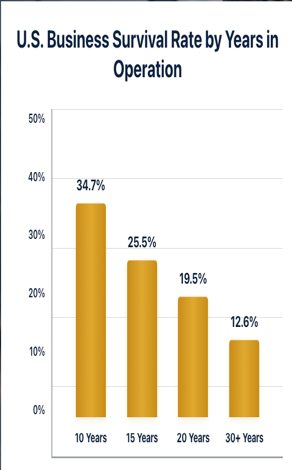
The average small business has booperating for 12 years (SBA Office of
Advocacy, 2024). BLS cohort- survival data shows what happens from there.
Enterprise Value: The Strategy That Turns
Your Business Into Financial Security
Ten tools. One plan. From what it's worth today to what it's worth at exit.
KNOW WHAT IT'S WORTH
1
Recast P&L
Troe owner earnings after add-backs (SDE)
2
3-Year P&L Summary
Revenue, gross profit, and net profit trends
3
3-Year P&L Summary
Real cash the business generates each year
4
3-Year P&L Summary
Valoe range based on SDE and multiples
5
Tax Return Reconciliation
Your P&L. matched to your tax filings
GROW WHAT IT'S WORTH
6
Nine Value Drivers
The actions that raise your multiple
7
Due Diligence Checklist
Documents ready for buyer review
8
Know Your Numbers
The metries every owner must traek
9
5-Year Forecast
Your roadmap from today’s value to exit value
10
Owner Assessment
30 questions: what a buyer would find today
Chartwell Value | chartwelivalue.com | Prepared by Terry Eck
CHARTWELL VALUE ADVISORY
What Actually Drives Enterprise Value
Four levers determine what a buyer will pay – and most owners have only ever thought about one of them.
Owners tend to think of value as a single number tied to revenue. Buyers think in four dimensions – and the gap between what an owner believes their business is worth and what it’s actually valued at almost always traces back to one or more of hese drivers being overlooked.
| Driver | What it measures | Why it moves the number |
|---|---|---|
| Cash Flow | The future income stream a buyer is actually purchasing — not the balance sheet | It's the foundation of every standard method: DCF, EBITDA multiples, SDE for smaller deals. No cash flow, no deal. |
| Risk | Customer concentration, margin stability, pipeline predictability | Risk sets the multiple. Identical profit can trade at 3x EBITDA for one business and 6x for another, purely on how risky that profit looks. |
| Growth | Trajectory, not just a snapshot | A flat $1M EBITDA business and one growing 20% a year are not the same asset — buyers pay for where the line is headed. |
| Owner Dependency | How much of the business walks out the door if the owner does | The single biggest value-suppressor in the lower middle market. A business that collapses without its owner isn't a business yet — it's a job. Buyers discount hard, or walk. |
THE WORKING DEFINITION
Enterprise value is what a buyer would actually pay – based on cash flow, risk, growth, and,
critically, how dependent the business is on the owner.
THE WORKING DEFINITION
Owners tend to think of value as a single number tied to revenue. Buyers think in four dimensions – and the gap between what an owner believes their business is worth and what it’s actually valued at almost always traces back to one or more of hese drivers being overlooked.
CHARTWELL VALUE ADVISORY
The Multiple Ladder - 1x to 10X
Every small business lands somewhere on this ladder. The zone sets the starting conversation. The value drivers decide where the final number lands within it.
The single thread running through all ten levels: every step up the ladder is about reducing buyer risk and proving the business runs without you. The jump from 3x to 6x – the core of the EV Blueprint Build – doesn’t require becoming a different kind of business. It requires becoming a documented, transferable version of the business you already have.
| × | What it means | Key requirements | Outcome |
|---|---|---|---|
| Distressed Zone — 1x to 2x | |||
| 1x | Fire sale / forced exit — buyer pays one year's earnings, and that's generous | No systems or processes · owner IS the business · no documented financials · no transferable customer relationships | Gary — closed without a sale |
| 2x | High risk, minimal transferability — heavy owner dependency, buyer needs heavy discounting | Few or no written processes · customers tied to owner personally · inconsistent revenue · no management layer | Ray — offer withdrawn at due diligence |
| Average Zone — 3x to 4x | |||
| 3x | Typical small business — the default market landing point for most Main Street businesses | Owner-dependent but functional · some recurring customers · basic bookkeeping only · revenue tied to owner relationships | Where most $1M–$5M businesses land today |
| 4x | Above average, early transferability — the business is starting to work for the owner, not just with them | Some written SOPs · staff can handle day-to-day · partial recurring revenue · clean P&L with some adjustments | Donald — strong exit at a premium |
| Strong Zone — 5x to 6x | |||
| 5x | Solid asset — buyer confident in transition; business can run without the owner for 30–60 days without crisis | Documented systems and processes · capable management layer · majority recurring or repeat revenue · clean, well-adjusted financials | EV Blueprint target floor — what the Build is designed to achieve |
| 6x | Premium small business — multiple qualified buyers give the seller negotiating leverage | Strong recurring revenue base · proven management team · audited or reviewed financials · low customer concentration | Owner transitioning out becomes possible |
| Premium Zone — 7x to 8x | |||
| 7x | Strategic asset — attracts institutional buyers; the business competes on value, not just price | Strong recurring/contractual revenue · proprietary process or IP · experienced second-tier management · 3+ years clean financials | Lower middle market — PE firms begin taking notice |
| 8x | Platform-ready — built to be acquired and scaled; the buyer sees a platform to bolt other businesses onto | Scalable infrastructure · technology or process advantage · predictable revenue with long contracts · minimal key-person risk anywhere | Institutional-grade small business — rare but achievable |
| Elite Zone — 9x to 10x | |||
| 9x | Near-institutional quality — competes with lower middle market companies for buyers | Recurring revenue above 70% · deep management bench · proprietary technology or data moat · category leader in niche market | Multiple strategic buyers competing — seller controls the process |
| 10x | Exceptional — best in class. Rare. When it happens, the business is irreplaceable in its market | Dominant market position · contractual or subscription revenue · operates fully without founder · clear path to 2x revenue post-sale | Exit headlines — the business others benchmark against |
CASE STUDY
Ray's Honest Inventory
Twelve years in, seen through a buyer’s eyes
Not the version Ray shows customers, but the version a buyer’s advisor would build during due diligence. The picture would be
clear.
Revenue is real and consistent. That is a genuine asset, and the foundation everything else can be built on.
The Gaps
| Area | What a Buyer Would Find |
|---|---|
| ✕Owner Dependence | Too much revenue is tied to Ray rather than to systems, a management team, or a brand that stands on its own. |
| ✕Financial Records | The financials need significant recasting before they are lender-ready. Personal expenses are mixed in, and reporting is informal. |
| ✕Management Team | No team is ready to carry the company through a transition. |
| ✕Documented Processes | The critical work isn't written down. Too much operating knowledge lives in Ray's head. |
| ✕Succession | No succession plan and no clear second-in-command. |
| ✕Valuation | Never formally valued. Ray's number is a guess based on a multiple he once heard at a conference. |
That does not make Ray a failure. It shows the gap between the business he built to produce income and the business he still needs to build if he wants that value to transfer.
The Next Work
Ray has already spent twelve years learning how to build and run a company. Closing the gap takes different work:
building what can carry on without him.
Leadership
A team that can run it
Systems
Processes on paper, not in
heads
Financial Clarity
Clean, lender-ready books
Relationships
Customers loyal to the
company
The gap is still closable.
He still has time, but only if he uses it.
Is your business closer to Ray’s than you’d like? Start with an EVO Snapshot and find out your number.
A SIDEBAR FROM OWN IT – IT OWNS YOU
Worth vs. Value
Two words every owner uses. Only one of them a buyer will honor.
Ask an owner what their business is worth, and you rarely get a market number. You get a story. It might be a figure overheard at a conference, or a multiple a friend used for a business that only sounded like theirs. More often, it is simpler than that: it is the number they need in order to retire, dressed up as a fact. “Worth” is not dishonest – it is personal. It carries the owner’s identity, their sweat equity, their years, the way an old car is “worth” more to the person who restored it than to anyone shopping for one.
Value speaks a different language entirely. It is backward-looking before it is anything else – built from the historical financials the business actually produced, not the ones the owner hoped for. It is calculated, not felt: an income approach, a market approach, an asset approach, each one indifferent to what the owner believes or needs. A buyer does not ask what retirement requires. A buyer asks what the cash flow supports, what the risk looks like, and how much of the business walks out the door if the owner does.
Worth is what you believe. Value is what someone else will pay. The distance
between them has a name – the GAP.